01What Artemis is
Artemis is NASA’s program to land humans on the Moon again, more than half a century after Apollo. Its aims are broader than Apollo’s flags-and-footprints sprint: to establish a sustained presence, focus on the resource-rich south pole, build lasting infrastructure in lunar orbit and on the surface, and use the Moon as a proving ground for an eventual crewed mission to Mars.
It is deliberately international and commercial. Europe, Japan and Canada build major hardware, private companies provide the landers and suits, and more than 50 nations have signed the Artemis Accords, a shared set of principles for how to operate on and around the Moon.
02Why go back to the Moon
- Sustained presence. Unlike Apollo, Artemis aims to return repeatedly and build infrastructure rather than visit once.
- Prepare for Mars. Nearly every deep-space system and human-health question can be rehearsed on the Moon, three days from home.
- Science and resources. The poles hold water ice and an ancient record of the Solar System, and the far side is prime ground for radio astronomy.
- Leadership and partnership. Artemis binds allies and companies into a shared program while other nations pursue their own lunar plans.
03How Artemis came to be
The program was formally named Artemis in 2019, directing NASA to return astronauts to the Moon. The name is apt: in Greek myth Artemis is the twin sister of Apollo, the goddess of the Moon — and NASA has emphasised that the program will land the first woman and the first person of colour on the lunar surface. Its rocket (SLS) and spacecraft (Orion) grew out of earlier programs, giving Artemis a running start on hardware.
04How the pieces fit together
A single Artemis landing is a relay of vehicles. The SLS rocket launches the Orion crew capsule toward the Moon. Orion enters lunar orbit, where it can dock with the Gateway station. A separately launched Human Landing System (HLS) meets the crew there and carries them down to the surface and back up. Orion then flies the crew home for an ocean splashdown. It is a very different architecture from Apollo’s single stack.
05The SLS rocket
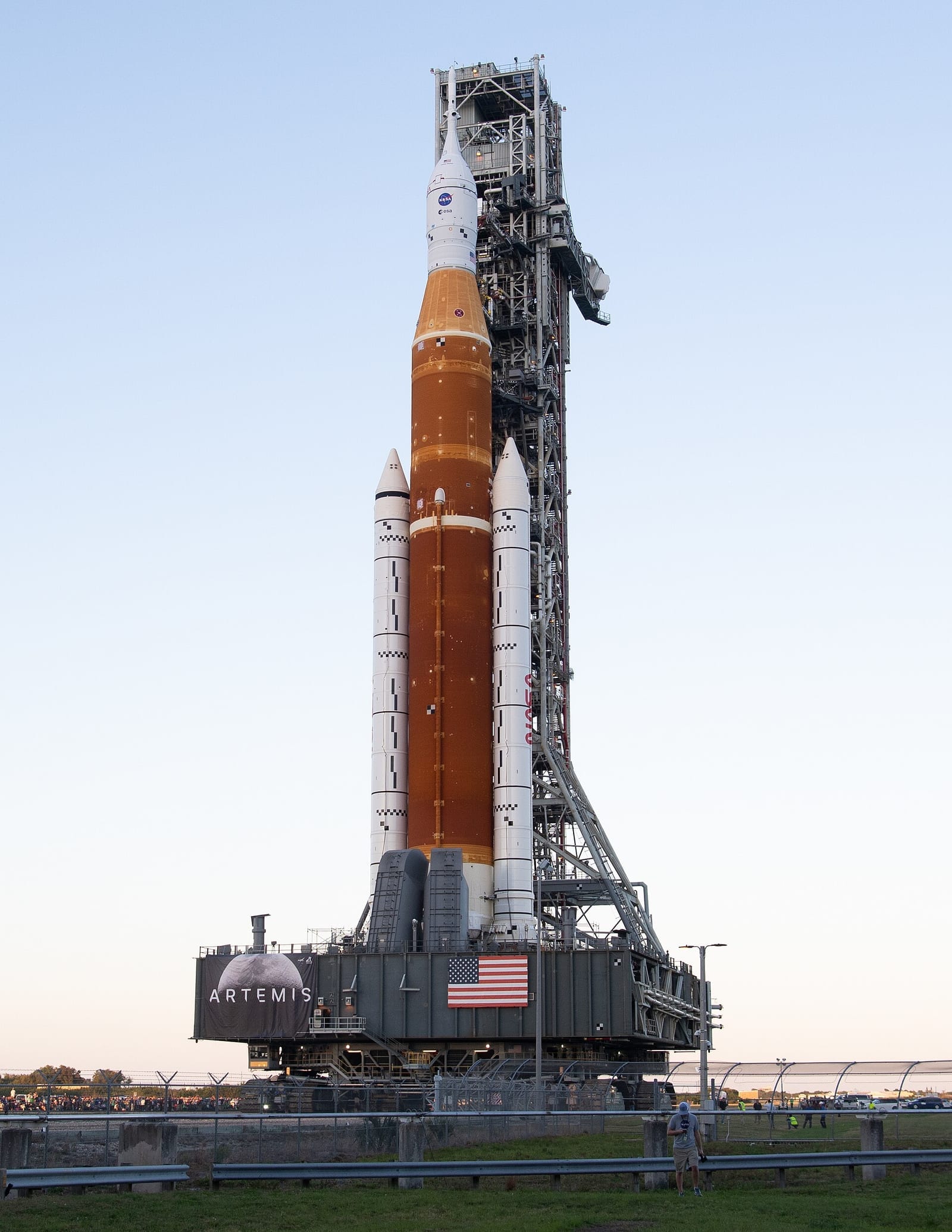
The Space Launch System (SLS) is NASA’s super-heavy rocket, built to send Orion and cargo beyond Earth orbit. Its core stage burns liquid hydrogen and oxygen through four RS-25 engines — the same engine family as the Space Shuttle — flanked by two solid rocket boosters. It is expendable, and its capability grows across planned configurations.
- Block 1 — the first version, which flew Artemis I, using an interim upper stage.
- Block 1B — adds the more powerful Exploration Upper Stage to lift more mass toward the Moon.
- Block 2 — a later, higher-performance configuration planned for the future.
06The Orion spacecraft
Orion is the crew vehicle that carries astronauts to lunar orbit and back. It has a crew module — built for up to four astronauts on deep-space missions — and a European Service Module, provided by ESA and built by Airbus, that supplies power, propulsion, air and water. Its heat shield is designed for the roughly 40,000 km/h re-entry of a return from the Moon, far faster and hotter than coming back from low Earth orbit.
Why the fast, hot re-entry matters
Returning from the Moon, Orion hits the atmosphere far faster than a capsule coming back from the space station. Qualifying its heat shield for that heating is one reason the early uncrewed flight came first — to test it before any crew flew.
07The Human Landing System
Orion cannot land on the Moon; a separate Human Landing System (HLS) does that. NASA chose commercial providers rather than building the lander itself, and selected two for redundancy and competition.
- Starship HLS — a lunar variant of SpaceX’s Starship, selected in 2021 as the first crewed lander. It refuels in Earth orbit before travelling to the Moon.
- Blue Moon — Blue Origin’s lander, selected in 2023 as a second provider, giving NASA two independent options for later landings.
08The Gateway station
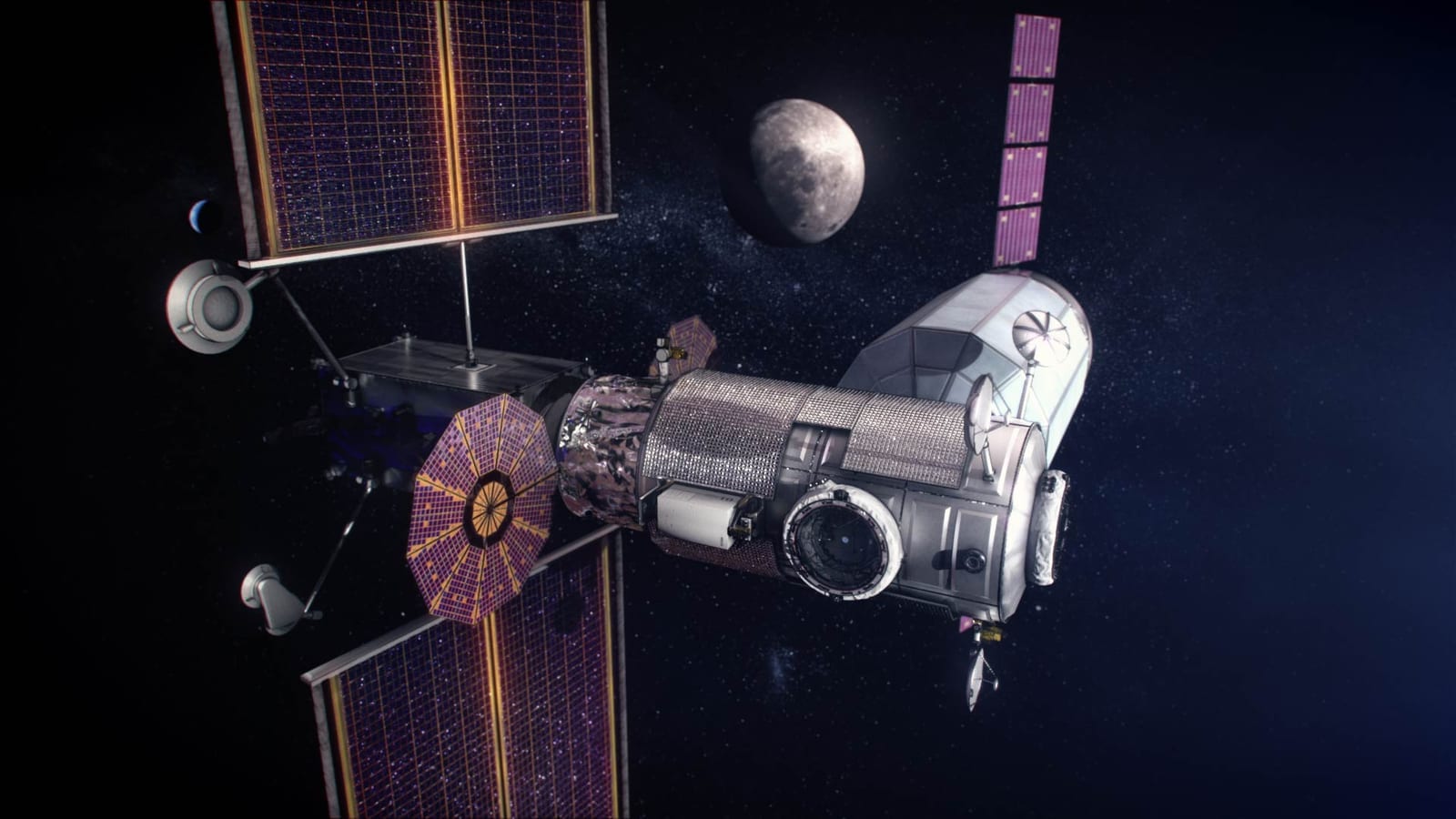
Gateway is a small space station being built in orbit around the Moon, in a stretched “near-rectilinear halo orbit”. It is where Orion and the lander can meet, a communications relay, a science platform and a staging point for surface missions. Its early modules include the Power and Propulsion Element and the HALO habitat, with major contributions from ESA (habitation and refuelling modules), JAXA and Canada (the Canadarm3 robotic arm).
09The Artemis spacesuits
Walking on the Moon needs a new suit. NASA contracted Axiom Space to provide the AxEMU surface suit for the first Artemis landing, designed for greater mobility than Apollo’s suits, to keep out abrasive dust and to work in the extreme cold near the south pole. Collins Aerospace held a parallel contract oriented toward the microgravity suit for the space station. Both use a services model in which companies own the suits and NASA buys their use.
10Artemis I (2022): the uncrewed test
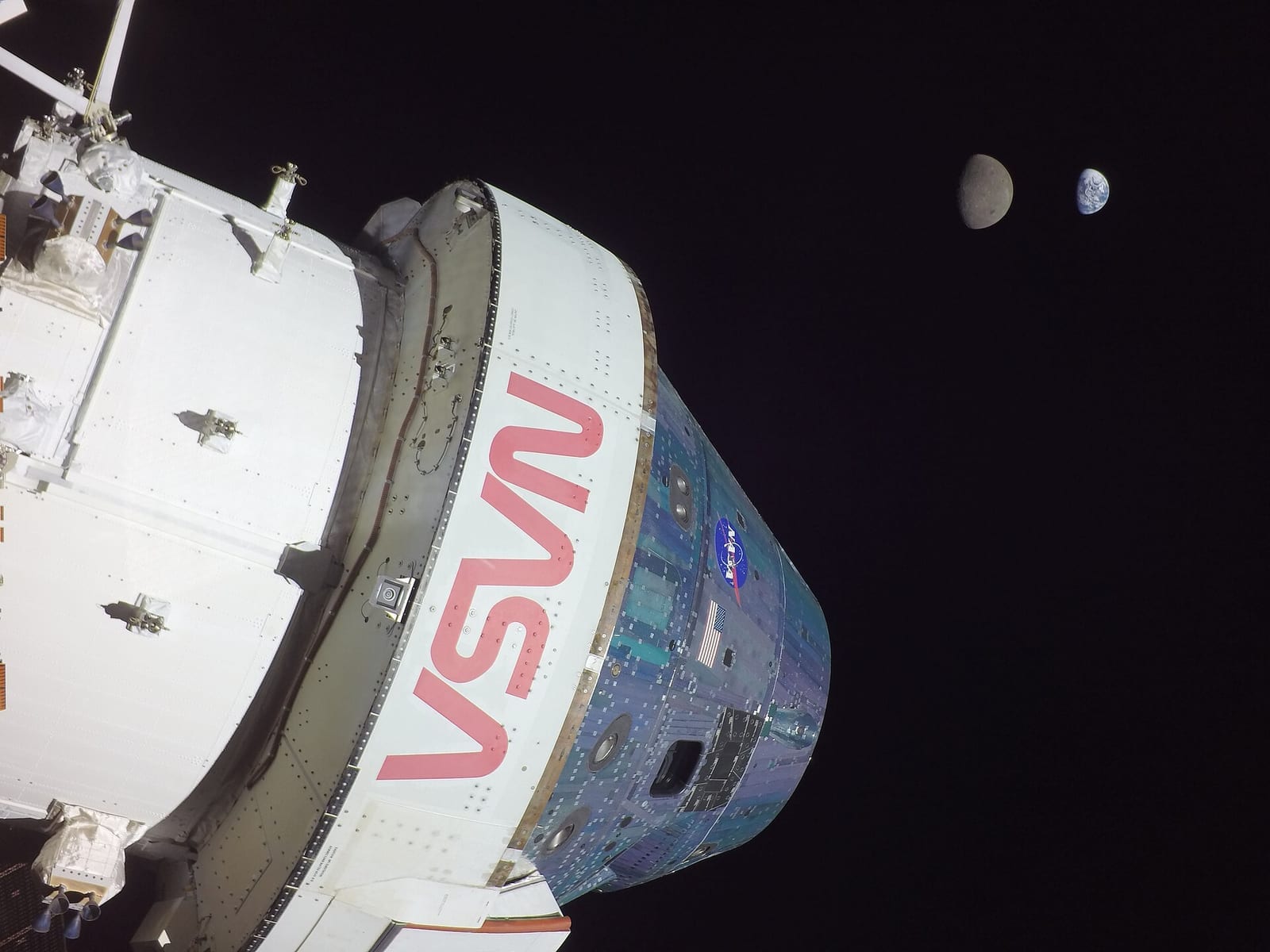
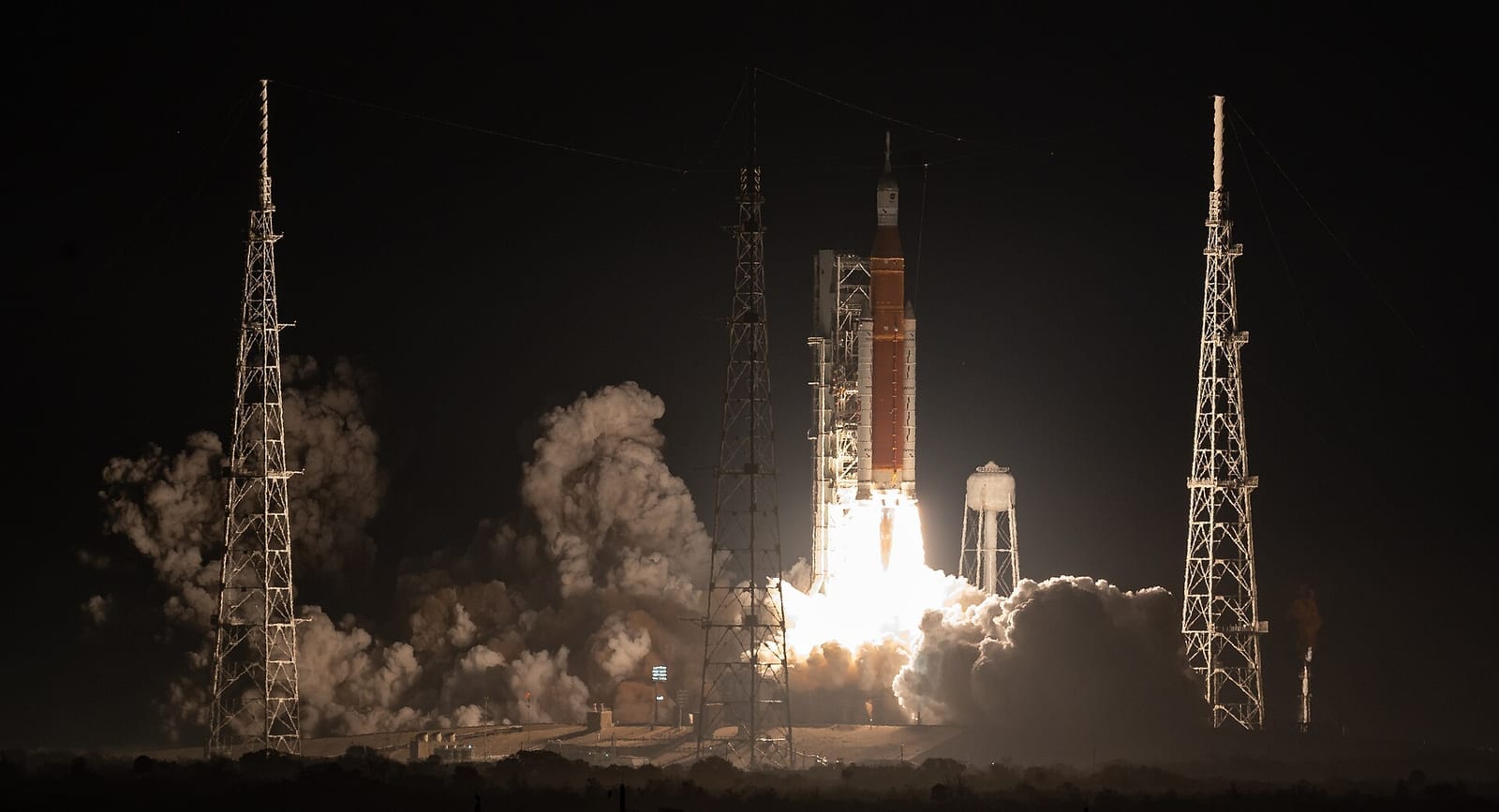
Artemis I flew in late 2022. SLS launched on 16 November 2022, sending an uncrewed Orion on a roughly 25-day flight that looped far beyond the Moon and back, before splashing down in the Pacific on 11 December 2022. It was the first integrated flight of SLS and Orion, and its main job was to prove the rocket, the spacecraft and — critically — the heat shield at lunar-return speeds before any crew flew. This mission is established fact.
11Artemis II: the first crewed flyby
Artemis II flew in April 2026 — the program’s first crewed mission, and the first flight to carry people to the Moon since 1972. SLS lifted off from Launch Complex 39B at Kennedy Space Center on 1 April 2026 at 6:35 p.m. EDT with Reid Wiseman (commander), Victor Glover (pilot), Christina Koch and Jeremy Hansen of the Canadian Space Agency aboard. Orion swung around the Moon on 6 April, passing about 4,067 miles (6,500 km) above the surface, and reached 252,756 miles (about 406,800 km) from Earth — farther than any crew had ever travelled, past the record Apollo 13 set in 1970. The crew returned more than 7,000 images of the lunar surface, watched the Moon eclipse the Sun from Orion’s windows, and splashed down in the Pacific off San Diego on 10 April at 5:07 p.m. PDT after nearly ten days and 695,081 miles of flight.
12Artemis III: the crewed docking rehearsal
Artemis III is no longer the landing. On 27 February 2026 NASA re-arranged the campaign into a step-by-step build-up: Artemis III, targeted for 2027, is to be a roughly two-week crewed test flight in low Earth orbit, where Orion rendezvouses and docks with test versions of both commercial landers — Blue Origin’s for about two days, then SpaceX’s Starship for about one — while the crew checks out the docked vehicles’ life support, comms and propulsion and the new xEVA suits. NASA named the crew on 9 June 2026: Randy Bresnik (commander), ESA’s Luca Parmitano (pilot), Andre Douglas and Frank Rubio, with Bob Hines as backup. The date remains a NASA target that depends on the landers and suits being ready.
13Artemis IV: the first landing, and beyond
Under the February 2026 architecture it is Artemis IV that carries the first crewed landing since Apollo 17 in 1972 — targeted for 2028, at the lunar south pole, on a commercial human landing system, with NASA saying it then wants at least one surface landing a year. Later missions are planned to build up the Gateway station, deliver base infrastructure, fly both Blue Origin’s Blue Moon and SpaceX’s Starship as landers, and carry international astronauts — including, under a NASA–JAXA agreement, a Japanese astronaut and the pressurized “Lunar Cruiser” rover. Everything from Artemis III onward is a target window, not a fixed date.
14International and commercial partners
- ESA (Europe) — builds Orion’s European Service Module and key Gateway modules.
- JAXA (Japan) — is to provide the pressurized rover and Gateway contributions, with Japanese astronaut flights in return.
- CSA (Canada) — provides the Canadarm3 robotic arm for Gateway; its astronaut Jeremy Hansen flew on Artemis II in 2026.
- Commercial — SpaceX and Blue Origin build the landers; Axiom and Collins the suits; and CLPS companies deliver robotic cargo and instruments.
15The Artemis Accords
The Artemis Accords, introduced in 2020, are a US-led set of principles for safe, transparent and peaceful lunar activity. They build on the 1967 Outer Space Treaty and cover interoperability, transparency, protection of heritage sites, sharing of scientific data, “safety zones” around operations, and a shared understanding that using space resources is permissible. More than 50 nations had signed by the mid-2020s. China and Russia lead a separate framework tied to their ILRS base plans.
16Robotic precursors: CLPS
Alongside the crewed flights, NASA buys rides on small commercial robotic landers through Commercial Lunar Payload Services (CLPS). These scout the surface, test technology and deliver science ahead of and between crewed missions. Intuitive Machines’ Odysseus made the first US soft landing since Apollo, and the first commercial one, in 2024; Firefly’s Blue Ghost landed in 2025. Not every attempt succeeds, which is expected of a low-cost, high-cadence program.
17SLS and Orion specifications
Approximate figures for the Block 1 configuration that flew Artemis I; values evolve across configurations.
| Parameter | Value (approx.) |
|---|---|
| SLS height (Block 1) | ~98 m |
| SLS liftoff thrust | ~39 MN (~8.8 million lbf) |
| Core stage engines | 4 × RS-25 (liquid H₂/O₂) |
| Boosters | 2 × five-segment solid rocket boosters |
| Orion crew capacity | up to 4 astronauts |
| Orion service module | European Service Module (ESA/Airbus) |
| Orion re-entry speed | ~40,000 km/h (lunar return) |
18Artemis vs Apollo
| Aspect | Apollo (1969–1972) | Artemis (2020s–) |
|---|---|---|
| Goal | Reach the Moon first; short visits | Sustained presence; prepare for Mars |
| Landing site | Equatorial regions | South pole (water ice) |
| Lander | NASA-built Lunar Module | Commercial HLS (Starship, Blue Moon) |
| Orbit infrastructure | None | Gateway station |
| Participants | United States alone | International + commercial partners |
19Program timeline
| When | Milestone |
|---|---|
| 2019 | The program is formally named Artemis. |
| 2020 | The Artemis Accords are introduced and first signed. |
| 2021 | NASA selects Starship HLS as the first crewed lander. |
| Nov–Dec 2022 | Artemis I flies uncrewed around the Moon and returns. |
| 2023 | Artemis II crew named; Blue Moon selected as second lander. |
| Feb 2026 | NASA re-arranges the campaign: Artemis III becomes an Earth-orbit test flight, the first landing moves to Artemis IV. |
| 1–10 Apr 2026 | Artemis II flies four astronauts around the Moon — the farthest humans have travelled from Earth. |
| Jun 2026 | Artemis III crew named (Bresnik, Parmitano, Douglas, Rubio). |
| Planned → | Artemis III crewed docking rehearsal in Earth orbit (2027), then the Artemis IV south-pole landing (2028) — target dates. |
20Interesting facts
- Artemis is named for the twin sister of Apollo, the Greek goddess of the Moon.
- Artemis I in 2022 was the first flight of SLS and Orion together, and it flew uncrewed.
- Orion’s service module — its power and propulsion — is built in Europe by ESA and Airbus.
- NASA plans to land the first woman and the first person of colour on the Moon under Artemis.
- The program aims for the lunar south pole, chosen for its water ice and near-continuous sunlight on ridges.
- Returning from the Moon, Orion re-enters at roughly 40,000 km/h — far faster than a return from the space station.
21Glossary
| Term | Definition |
|---|---|
| Artemis | NASA’s international program to return crews to the Moon and prepare for Mars. |
| SLS | Space Launch System — the super-heavy rocket that launches Orion toward the Moon. |
| Orion | The crew capsule (with a European service module) that carries astronauts to lunar orbit and back. |
| HLS | Human Landing System — the lander that takes crews from lunar orbit to the surface. |
| Gateway | A small space station in lunar orbit serving as a meeting point, relay and science platform. |
| NRHO | Near-rectilinear halo orbit — Gateway’s stretched, stable orbit around the Moon. |
| AxEMU | Axiom Extravehicular Mobility Unit — the next-generation Artemis surface spacesuit. |
| CLPS | Commercial Lunar Payload Services — robotic landers delivering NASA cargo to the Moon. |
| Artemis Accords | A US-led set of principles for safe, transparent, peaceful lunar activity. |
| RS-25 | The liquid hydrogen/oxygen engine, from the Shuttle era, powering the SLS core stage. |
Continue exploring
22Frequently asked questions
What is the Artemis program?
NASA’s international program to return astronauts to the Moon — targeting the south pole for a sustained presence — using the SLS rocket, the Orion spacecraft, commercial landers and the Gateway station.
Why is it called Artemis?
Artemis is the twin sister of Apollo and the Greek goddess of the Moon — a fitting name for the successor to the Apollo landings, and NASA emphasises it will land the first woman on the Moon.
Did Artemis I really fly?
Yes. Artemis I launched on 16 November 2022, sent an uncrewed Orion around the Moon, and splashed down on 11 December 2022. It was the first flight of SLS and Orion together.
Was there a crew on Artemis I?
No. Artemis I was uncrewed by design, carrying instrumented mannequins to test conditions before people fly. Its purpose was to prove the rocket, capsule and heat shield.
What is Artemis II?
The program’s first crewed mission, flown 1–10 April 2026: four astronauts looped around the Moon without landing and splashed down in the Pacific, travelling farther from Earth than any crew before them.
What is Artemis III?
Since NASA’s February 2026 re-arrangement, a crewed test flight in Earth orbit targeted for 2027: Orion is to dock with test versions of the Blue Origin and SpaceX landers and check out the new spacesuits. The first landing is now Artemis IV.
Who are the Artemis II astronauts?
Reid Wiseman (commander), Victor Glover (pilot) and Christina Koch of NASA, with Jeremy Hansen of the Canadian Space Agency. Named in 2023, they flew the mission in April 2026.
What is the SLS rocket?
The Space Launch System, NASA’s expendable super-heavy rocket, which launches Orion toward the Moon using four RS-25 engines and two solid rocket boosters.
What is Orion?
The crew spacecraft that carries up to four astronauts to lunar orbit and home, with a European Service Module (built by ESA and Airbus) supplying power, propulsion, air and water.
What is the Human Landing System?
The lander that carries crews from lunar orbit to the surface. NASA selected a lunar Starship (2021) and Blue Origin’s Blue Moon (2023) as its two providers.
What is Gateway?
A small space station being built in orbit around the Moon, serving as a meeting point for Orion and landers, a communications relay, and a science platform, with international partners.
How is Artemis different from Apollo?
Artemis targets the south pole (not the equator), aims for a sustained presence rather than short visits, uses commercial landers and the Gateway station, and is international rather than US-only.
Who are the partners in Artemis?
ESA, JAXA and CSA build major hardware; SpaceX and Blue Origin build the landers; Axiom and Collins the suits; CLPS companies fly robotic cargo — and more than 50 nations have signed the Artemis Accords.
When will Artemis land people on the Moon?
No date is confirmed. The crewed flyby (Artemis II) is done; next come the Artemis III docking rehearsal in Earth orbit, targeted for 2027, and then the Artemis IV south-pole landing, targeted for 2028 — both NASA target windows that have moved more than once.
What are the Artemis Accords?
A US-led set of principles, introduced in 2020, for safe, transparent and peaceful lunar activity, building on the Outer Space Treaty. More than 50 nations had signed by the mid-2020s.
23Sources
- NASA — Artemis ↗
- NASA — Artemis I mission ↗
- NASA — Artemis II mission ↗
- NASA — Artemis II crew back on Earth (record-setting flight) ↗
- NASA — adds mission to Artemis program, updates architecture (Feb 2026) ↗
- NASA — Artemis III crew named, 2027 mission ↗
- NASA — Space Launch System ↗
- NASA — Orion spacecraft ↗
- NASA — Gateway ↗
- ESA — Orion European Service Module ↗
- U.S. Department of State — Artemis Accords ↗