01What a Moon base is
A Moon base is a long-term, crewed outpost on the lunar surface — not a single Apollo-style visit, but infrastructure where astronauts live and work for weeks or months and where systems keep running between crews. NASA calls its version “Artemis Base Camp”: a habitat, a rover or two, power and communications, growing one mission at a time near the lunar south pole.
The Moon matters for two reasons. It is a destination in its own right — for science, resources and prestige — and it is a rehearsal for Mars. Nearly every hard problem of living on another world (radiation, dust, closed-loop life support, power through the dark, staying alive far from rescue) can be tested on the Moon, only three days away, before crews ever risk the seven-month trip to Mars.
02Why build a base on the Moon
No single reason drives the return to the Moon. The case stacks several motives on top of one another.
- A stepping stone to Mars. The Moon lets agencies test deep-space hardware and human health three days from home rather than months.
- Science. The far side is a radio-quiet place for astronomy; the poles preserve a frozen record of the inner Solar System in their ancient ice.
- Resources. Polar water ice can become drinking water, breathable oxygen and rocket propellant, and regolith can be turned into oxygen and building material.
- Economy and industry. A cislunar economy — landers, comms relays, mining, tourism — is a plausible market long before Mars.
- Geopolitics. The United States, China, Russia, Europe, Japan, India and others are all planning lunar activity, making the Moon a focus of cooperation and competition alike.
03Who is planning lunar bases
Two broad coalitions dominate serious base planning, alongside a growing set of commercial landers. Goals and timelines differ, and every crewed date below is a stated target, not a guarantee.
| Organization | Goal on the Moon | Stated timeframe |
|---|---|---|
| NASA + Artemis partners | Crewed south-pole landings and a growing “Artemis Base Camp”, with the Gateway station in lunar orbit. | First crewed landing targeted this decade; base build-up through the 2030s (targets, not confirmed). |
| China (CNSA) + ILRS | The International Lunar Research Station, a robotic-then-crewed base led with Russia and other partners. | Crewed landing targeted around 2030; base build-out through the 2030s (targets). |
| ESA, JAXA, CSA | Major Artemis contributions — Orion’s service module, Gateway modules, a pressurized rover and robotics — rather than solo bases. | Contributions across the late 2020s–2030s. |
| Commercial (CLPS & others) | Robotic landers, cargo delivery, rovers and services — the supply chain a base would rely on. | Regular robotic landings already underway. |
04Where on the Moon a base would sit
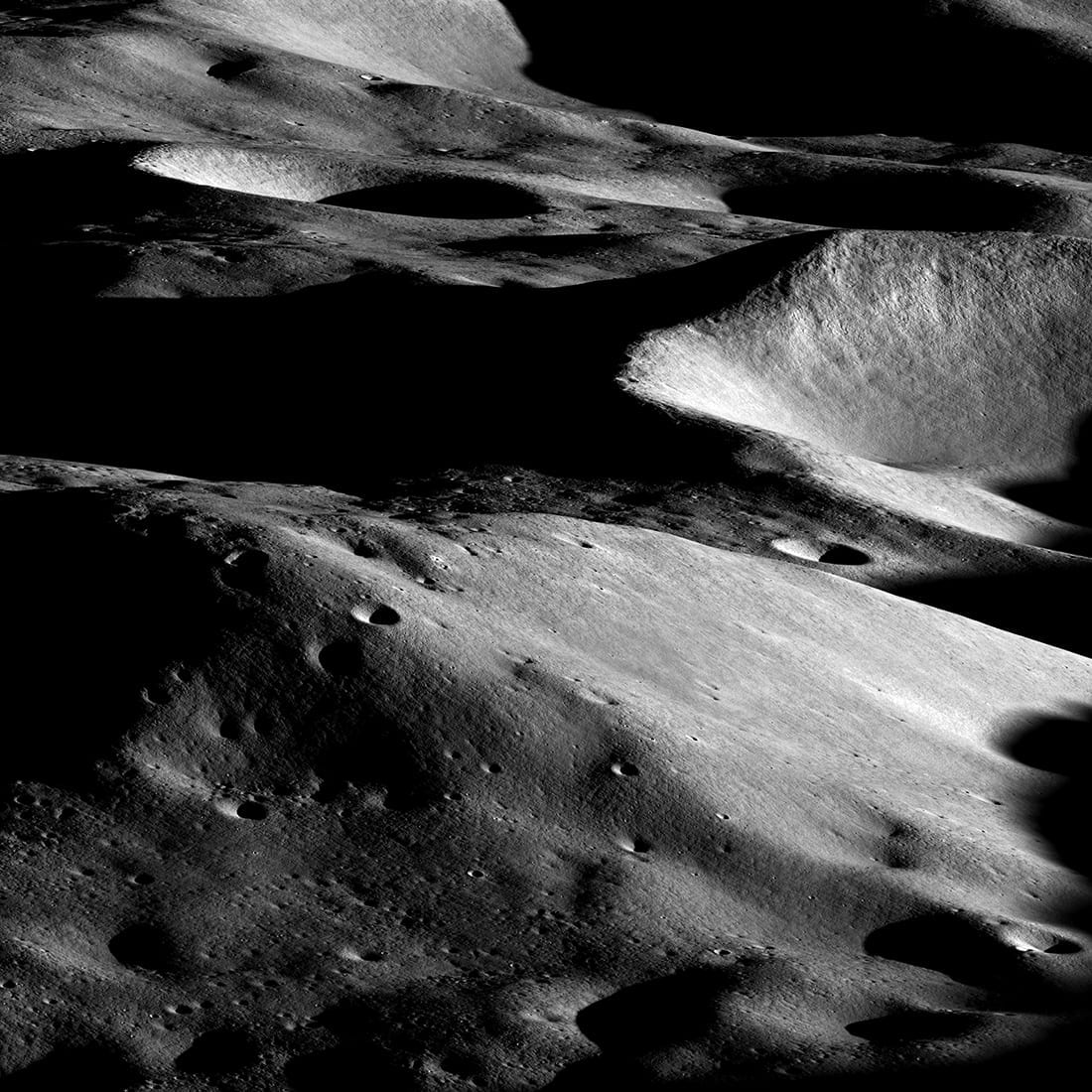
Almost every modern plan points to the lunar south pole. The reason is a rare combination of geography: crater rims and ridges that catch near-continuous sunlight for power, sitting right beside permanently shadowed crater floors cold enough to have trapped water ice for billions of years.
- “Peaks of eternal light” — ridges near the pole lit for most of the lunar year, giving solar power far steadier than anywhere else on the Moon.
- Permanently shadowed regions (PSRs) — crater floors that never see the Sun, where temperatures fall low enough to hold water ice and other frozen volatiles.
- NASA published candidate landing regions near the south pole for Artemis; the exact site depends on lighting, terrain and ice access.
Why not the equator?
Apollo landed near the equator, but there the Sun sets for about 14 Earth days at a time and there is no accessible ice. The poles trade harder terrain for steadier power and local water — decisive for a permanent base.
05Habitats, radiation and micrometeorite shielding
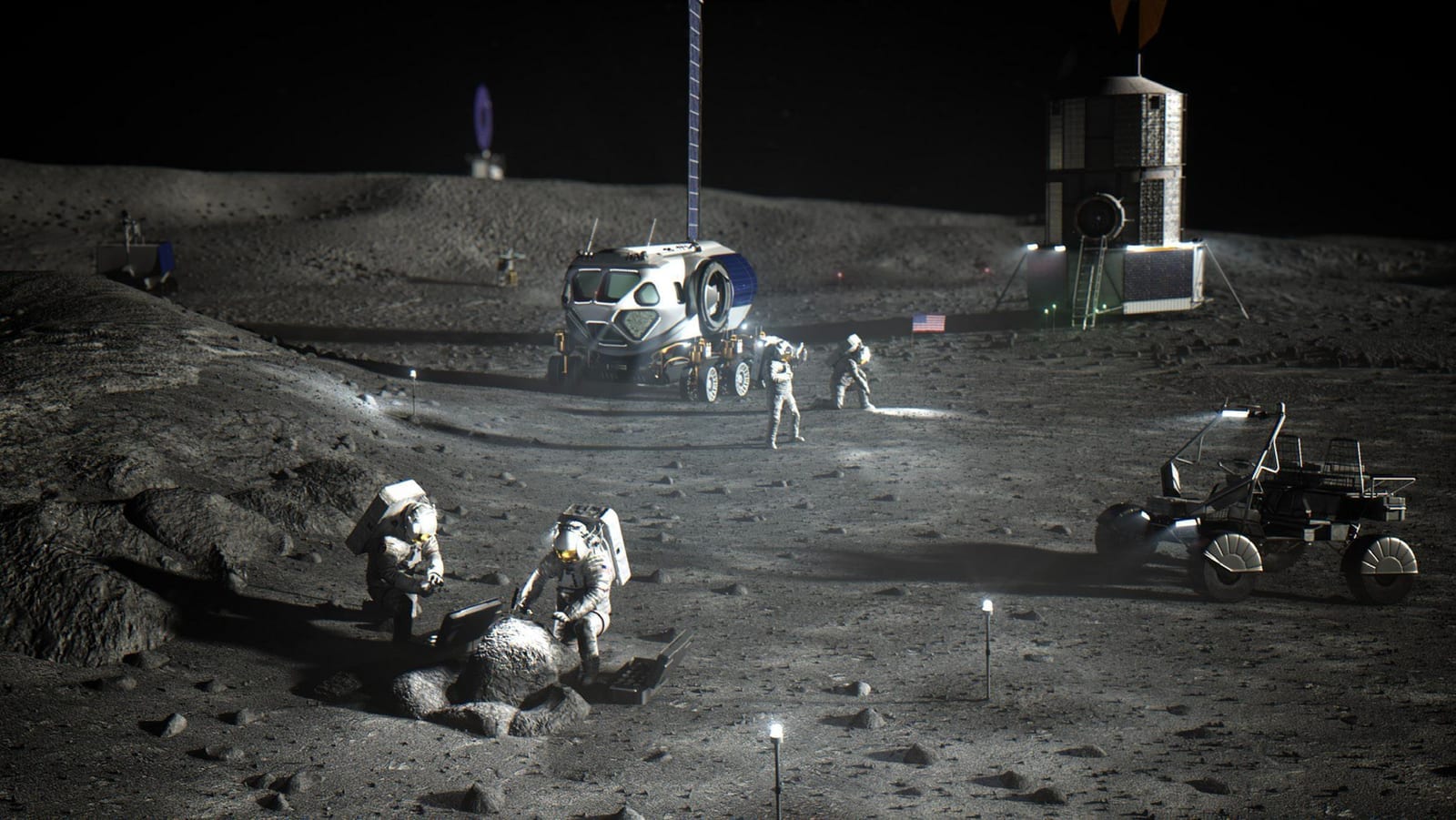
The Moon has no atmosphere and no global magnetic field, so the surface is exposed to galactic cosmic rays and to sudden solar particle events. A thin metal hull is fine for a short stay but not for months. The cheapest effective shield is mass, and the cheapest mass is already there: regolith.
- Regolith-covered modules. Piling a few metres of lunar soil over a habitat cuts radiation dose sharply and blocks the constant rain of micrometeorites, which face no atmosphere to burn them up.
- Inflatable and rigid modules for the first crews, delivered ready to pressurize and then buried or bermed for protection.
- 3D-printed structures. ESA and NASA both study printing walls and berms from melted or bound regolith, so structures don’t all have to be shipped from Earth.
Lava-tube shelters
Orbiters have found pits and evidence of intact lava tubes — natural tunnels left by ancient volcanism. Their thick rock roofs would provide radiation, micrometeorite and thermal protection “for free”, and researchers see them as strong candidates for long-term shelter, though none has yet been explored from the surface.
06Water ice and in-situ resources
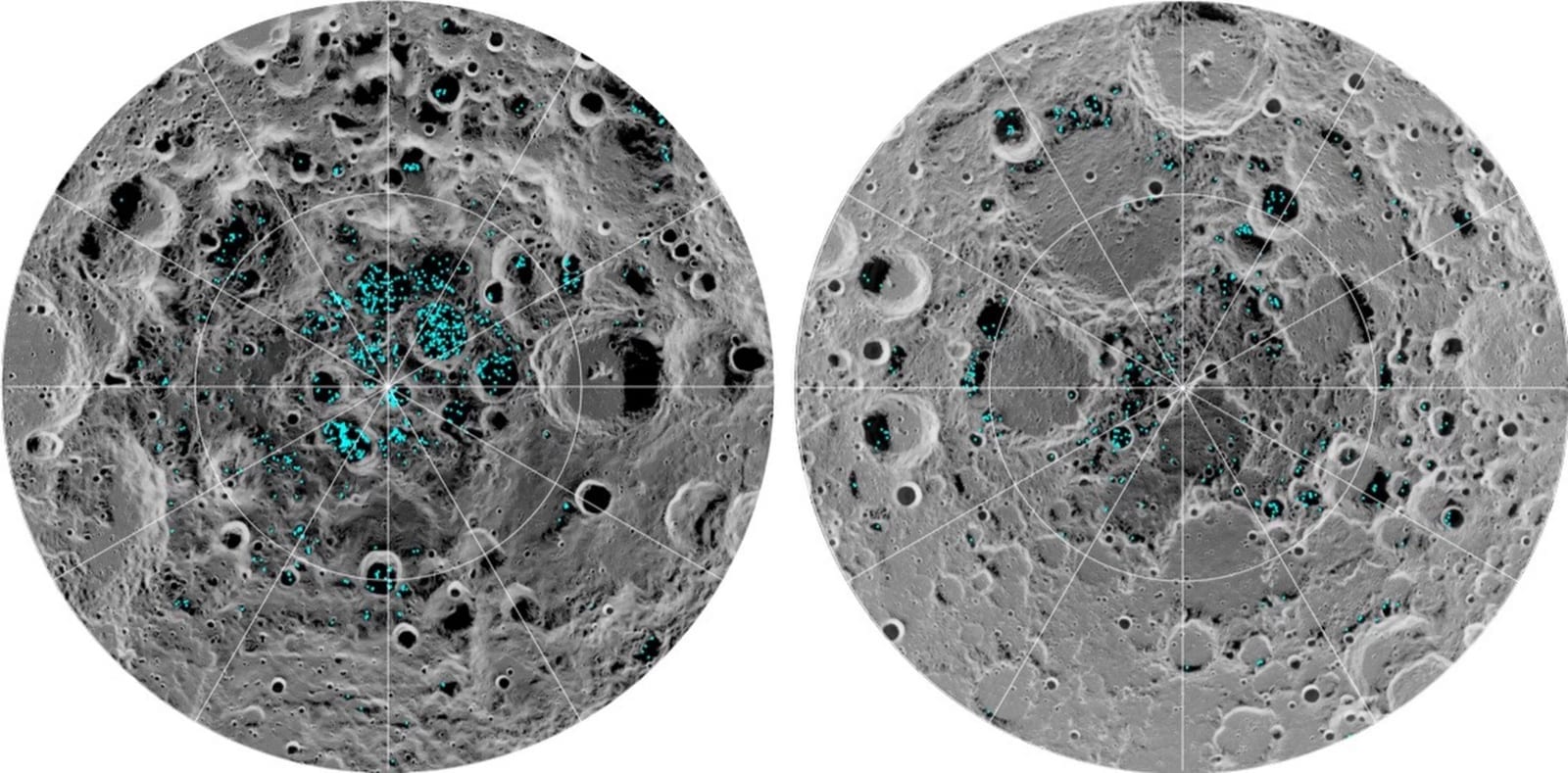
Water is the resource that makes a lunar base plausible. Multiple missions — from Lunar Prospector and Chandrayaan-1 to LCROSS and the LRO — have found strong evidence of water ice and hydrogen concentrated in the polar cold traps. On the surface, water becomes drinking water, breathable oxygen (by splitting it), and, combined with the oxygen, hydrogen rocket propellant.
This idea has a name: in-situ resource utilization (ISRU) — using local materials instead of shipping everything from Earth. Extracting polar ice is hard: it may be mixed into extremely cold, hard-frozen regolith, in the dark, at temperatures near −200 °C. NASA’s VIPER-class rovers and CLPS instruments are meant to map exactly how much ice there is and how easy it is to reach — the difference between an interesting fact and an economic base.
07Power: solar peaks and surface fission
Power is the make-or-break system, because the Moon has no fuel to burn and its day–night cycle is brutal. Base designs lean on two sources, usually together.
- Solar at the poles. On the “peaks of eternal light”, vertical solar arrays can be lit most of the time, giving far steadier power than at the equator, where night lasts about 14 Earth days.
- Fission surface power. NASA’s Kilopower project and its KRUSTY test demonstrated a compact reactor, and the Fission Surface Power initiative targets a lander-deliverable unit on the order of ~40 kW — steady output that ignores dust, shadow and the long night.
- Energy storage. Batteries or regenerative fuel cells must carry critical loads through any shadow period — heavy, and one of the hardest parts of surviving the lunar night.
08Thermal extremes and the 14-day night
Because the Moon rotates once per orbit, a point on the equator gets roughly 14 Earth days of sunlight followed by about 14 days of darkness. Surface temperature swings from well above the boiling point of water in daylight to about −130 °C at night, and permanently shadowed crater floors sit near −200 °C or lower. Keeping hardware and crews within survivable limits through that swing — and through the fortnight-long night without solar power — is one of the base’s central engineering problems, which is another reason the poles, with their milder lighting, are preferred.
09Lunar dust: abrasive and electrostatic
Apollo crews called dust the number-one problem on the surface. Lunar regolith is not like sand: it was ground by billions of years of micrometeorite impacts into jagged, glassy grains that were never weathered smooth. It is abrasive, it clings electrostatically to everything, and it damaged Apollo seals, spacesuits and instruments within days.
- Mitigation ideas include dust-tolerant seals and connectors, electrodynamic “dust shields” that shed charged grains, airlocks and suit-ports that keep dust outside, and coatings that resist sticking.
- Inhaled fine dust is a health hazard, so keeping the habitat interior clean is a life-support issue, not just a housekeeping one.
10Life support, air and food
A base needs to recycle almost everything. The International Space Station already recovers most of its water and much of its oxygen; a lunar base extends that toward a tighter closed loop, topped up with locally produced oxygen and water from ice and regolith. The less that has to be flown from Earth, the cheaper and safer the base.
- Air. Oxygen from split water or extracted from regolith; carbon dioxide scrubbed and, ideally, recycled.
- Water. Recovered from humidity and waste, and topped up from mined polar ice.
- Food. Early crews rely on shipped supplies; longer stays add hydroponic greens grown under artificial light, an active research area on the ISS and on the ground.
11Communications and navigation
The Moon is close enough that the radio delay is only about 1.3 seconds each way — real-time conversation is possible, unlike Mars. The harder problem is coverage: the far side never faces Earth, and the deep polar craters block direct line of sight. The answer is dedicated infrastructure.
- LunaNet — NASA’s framework of interoperability standards so that comms and navigation services from different providers work together, like a “lunar internet and GPS”.
- Relay satellites — orbiters that link the far side and polar regions back to Earth; ESA’s Moonlight and various commercial constellations aim to provide this.
- The Gateway station in lunar orbit can also serve as a communications relay and staging point for surface crews.
12Getting around: rovers and mobility
Astronauts on foot can cover only a small area, so mobility widens what a base can reach. NASA plans an unpressurized Lunar Terrain Vehicle (LTV) — an open “Moon buggy” for short trips — and, with international partners, a pressurized rover that lets crews drive for days in a shirtsleeve cabin. In 2024 NASA and Japan (JAXA/Toyota) agreed that Japan would provide a pressurized rover, the “Lunar Cruiser”, in exchange for Japanese astronaut flights.
13Who owns the Moon: the legal frame
No country can own the Moon. The 1967 Outer Space Treaty, ratified by all major spacefaring nations, says space is not subject to national appropriation and must be used for peaceful purposes. It does not, however, spell out clear rules for extracting and using resources — the practical question a base raises.
- The Artemis Accords (2020) are a US-led set of principles for safe, transparent cooperation — including “safety zones” around operations and a shared interpretation that resource use is allowed. More than 50 nations had signed by the mid-2020s.
- The Moon Agreement (1979) called lunar resources the “common heritage of mankind”, but few nations ratified it and none of the major powers did, so it carries little practical weight.
- China and Russia lead a separate ILRS framework, so two partly overlapping visions of lunar governance now coexist.
14A realistic economic outlook
The honest picture is that a lunar base is expensive and, for now, government-funded. NASA’s Artemis campaign runs to tens of billions of dollars, and no lunar activity yet turns a profit on its own. The economic case rests on services and cost curves rather than on shipping rocks to Earth.
- Near term: government contracts — landers (CLPS), cargo, comms relays, rovers and instruments — form a real but subsidised market.
- Medium term: propellant made from lunar ice could refuel spacecraft in cislunar space, and reusable landers plus cheaper heavy-lift could cut the cost per kilogram to the surface.
- Long term and speculative: mining rare materials or helium-3 is often cited, but there is no proven market and the physics and economics remain unresolved — treat such claims with caution.
15What the first Moon base could look like
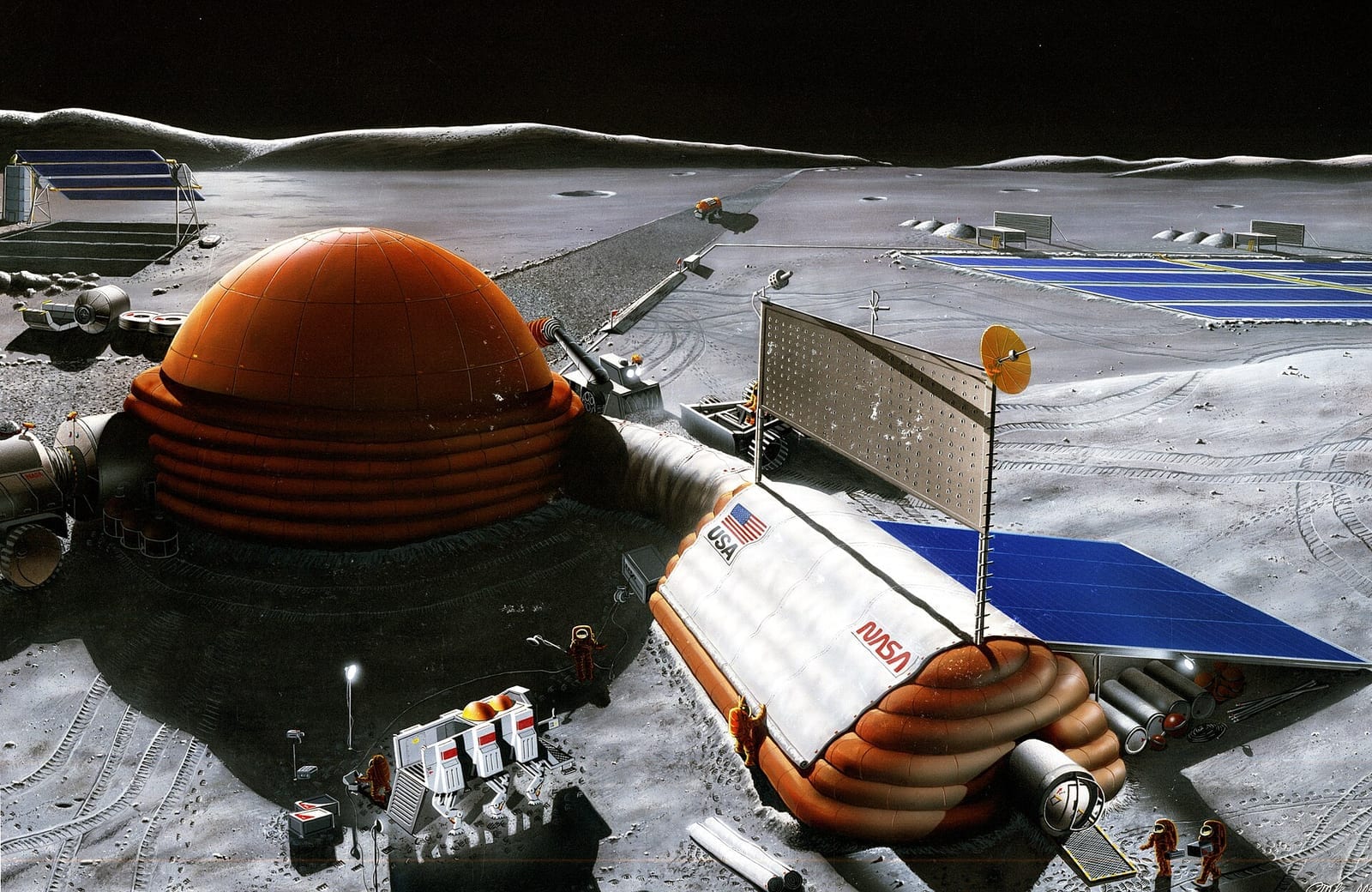
The first base won’t be a glass dome. Expect a compact, modular outpost near the south pole, growing as each landing arrives: a shielded habitat, a power source, energy storage for the dark, a rover or two, and a small ISRU plant testing oxygen and water extraction. Most of it sits low and covered — the opposite of the tall, gleaming cities of film.
- Habitation — a pressurized module, shielded with regolith or sited near a lava tube.
- Power and storage — solar on a polar ridge plus batteries, or a surface fission reactor.
- ISRU pilot — a plant that extracts oxygen from regolith and water from polar ice.
- Mobility and comms — rovers for range and a relay link back to Earth via LunaNet or Gateway.
16When a permanent base could exist
No date is certain, and lunar timelines have a long history of slipping. What can be said fairly is the shape of current plans.
- The first crewed landing is now Artemis IV, targeted for 2028 after NASA re-arranged the campaign in February 2026; the date still depends on the lander, the suits and the rocket all being ready — targets that have already moved.
- A recurring surface presence — the beginnings of a base — is a stated goal for the 2030s, built up mission by mission rather than opened all at once.
- A truly self-sufficient base that produces most of its own air, water and power is a multi-decade proposition, and much of it still depends on unproven ISRU at scale.
17Frequently asked questions
Can humans live on the Moon permanently?
Not yet, but it is the goal of current programs. A permanent base needs shielding, reliable power through the 14-day night, and local water and oxygen — all being developed but not yet proven together on the surface.
Is there water on the Moon?
Yes — as ice concentrated in permanently shadowed craters near the poles, confirmed by missions including LCROSS and Chandrayaan-1. How much is accessible is still being mapped.
Can you breathe on the Moon?
No. The Moon has essentially no atmosphere, so all oxygen must be produced and kept inside sealed habitats or suits. Oxygen can be extracted from water ice or from the regolith itself.
How long is a day on the Moon?
The full day–night cycle lasts about 29.5 Earth days, so a spot on the equator gets roughly 14 days of sunlight and 14 days of darkness. The poles have far more constant lighting.
Why build a base at the lunar south pole?
Because it combines near-continuous sunlight on high ridges (for power) with permanently shadowed craters that hold water ice (for resources) — a pairing found nowhere near the equator.
How would a base survive the 14-day night?
Either by siting at a polar “peak of eternal light” that avoids long darkness, by storing energy in batteries or fuel cells, or by using a surface fission reactor that runs regardless of sunlight.
How dangerous is radiation on the Moon?
With no atmosphere or magnetic field, the surface receives far more cosmic and solar radiation than Earth. A few metres of regolith over a habitat, or a lava tube, provides effective shielding.
Why is lunar dust such a problem?
Regolith grains are jagged and glassy, never smoothed by weathering. The dust is abrasive, clings electrostatically to everything, and is a hazard to seals, suits, machinery and lungs — Apollo crews rated it their top nuisance.
What are lava tubes and why do they matter?
They are natural underground tunnels left by ancient volcanism. Their thick rock roofs would shield crews from radiation, micrometeorites and temperature swings, making them attractive candidate shelters — though none has yet been explored from the surface.
How far is the Moon and how long does it take to get there?
The Moon averages about 384,000 km from Earth, and a crewed spacecraft typically reaches it in about three days — a huge advantage over the roughly seven-month trip to Mars.
Does communication with the Moon have a delay?
Only about 1.3 seconds each way, so real-time conversation is possible. The bigger challenge is coverage of the far side and deep polar craters, which needs relay satellites and standards like LunaNet.
Who owns the Moon?
No one. The 1967 Outer Space Treaty bars any nation from claiming it. The Artemis Accords and the separate ILRS framework set out how their partners intend to cooperate and use resources.
Can food be grown on the Moon?
Not outdoors, but inside habitats using hydroponics under artificial light. Early crews will rely mostly on shipped supplies; reliable off-Earth food production is still an active research area.
When will there be a permanent Moon base?
No date is confirmed. NASA targets 2028 for the first crewed landing (Artemis IV) and a recurring surface presence in the 2030s, but these are stated goals that have slipped before.